Call or Text us: (929) 605-4397

Author: frycupsadmin

  • How to Choose Custom Fry Cups for Your Brand

    How to Choose Custom Fry Cups for Your Brand

    How to Choose Custom Fry Cups for Your Brand: Use Cases and Ordering

    The best way to choose custom fry cups is to start from how they will be used, then work back to the material, size, and decoration that fit. Custom fry cups serve very different jobs across food service, e-commerce inserts, retail & branding, and events, and matching the order to the job is what makes custom fry cups feel purpose-built rather than generic. This guide maps the common use cases and walks through ordering custom fry cups that fit your brand.

    Whether the fry cups protects a product, presents a gift, or carries a logo into the world, defining that job first keeps every later decision easy. Purpose drives the spec, and the spec drives the result.

    How brands use custom fry cups

    Custom fry cups get ordered for a mix of protection, presentation, and promotion, and knowing where yours fall points you to the right build. The breakdown below shows the common uses, from food service to events.
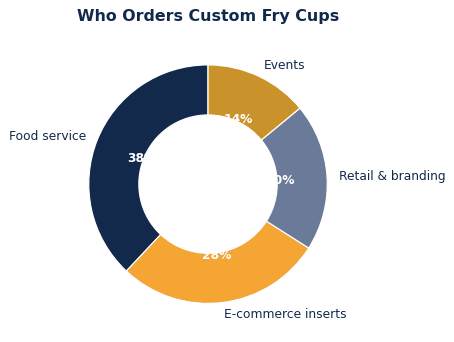
    The common ways brands put custom fry cups to work.
    The common ways brands put custom fry cups to work.

    Most orders lean toward one primary job with a secondary benefit — a shipping-focused fry cups that also brands the unboxing, or a gift-focused one that also protects. Naming your primary use keeps the order focused and the spec appropriate.

    Use case What it needs
    Food service branded, food-safe paper that dresses up a serve
    E-commerce inserts thank-you and instruction cards that build loyalty
    Retail & branding labels and wraps that reinforce the brand
    Events printed pieces that tie a theme together

    Matching material and size to the use

    Once the use is clear, the material and size follow. A protection-first job favors a durable, well-fitted build; a presentation-first job favors a premium material and a clean print; a promotion-first job favors a cost-effective option you can order in volume. Sizing to the product with a small margin keeps the fry cups looking intentional and performing its job.

    If a single order serves more than one use, spec to the most demanding one so the fry cups performs everywhere. It is easier to use a slightly sturdier or more premium fry cups across the board than to discover a bargain option falls short for your most important use case.

    Branding for the impression you want

    Decoration should reinforce the impression the use calls for. Digital and offset printing reproduce full-color art crisply, with spot colors and foil available for a premium touch. For a premium or gift use, lean on finishes and restraint; for high-volume promotion, prioritize a bold, legible logo that reads at a glance and reproduces affordably at scale. Keep branding consistent with the rest of your packaging or merch so everything reads as one system.

    The most-requested options below reflect what buyers reach for most, and they are a useful starting menu when you brief your order. Whatever you choose, approve a proof so the finished custom fry cups match the impression you intended.
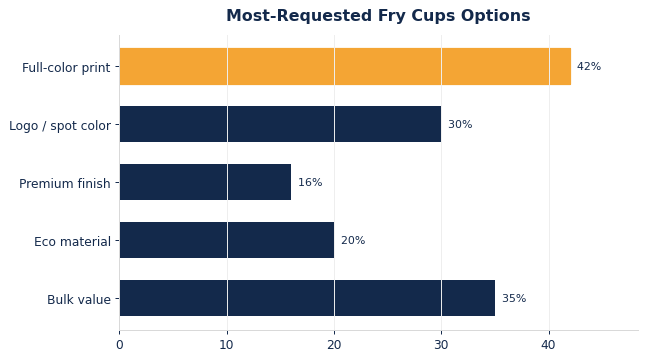
    The options buyers request most on custom fry cups.
    The options buyers request most on custom fry cups.

    Getting the size and details right

    Even with the use and material decided, the details are what make custom fry cups feel finished. Confirm the size and weight against the product with a small margin, check the print area for your chosen size so the logo sits cleanly, and decide on any finishing touches before you brief the order. These small confirmations up front are what separate a fry cups that looks intentional from one that looks close-enough.

    A sample or proof is the cheapest insurance you can buy on a fry cups order. A physical sample lets you judge the material and print in hand, while a digital proof confirms artwork, color, and size and weight before the full run. Spending a few minutes here prevents the far larger cost of reworking a finished order of custom fry cups that missed on a detail.

    Ordering: quantities, lead time, and reorders

    A smooth fry cups order comes down to a few basics: order for real demand plus a small overage, send print-ready artwork early, and confirm lead time against any deadline so production and shipping fit your timeline. Per-unit cost drops with volume, so consolidating a season’s needs into one run is usually more efficient than repeated small orders.

    Keep your approved artwork and spec on file so reorders are a quick repeat rather than a fresh setup each time — consistency across runs keeps your brand looking deliberate.

    Coordinating with the rest of your brand

    Custom fry cups rarely stand alone; they sit alongside your other packaging, print, or merch, so coordinating them strengthens the whole brand. Carrying the same logo, colors, and tone across your fry cups and your other pieces makes everything read as one deliberate system rather than a set of one-off orders. That consistency is what makes a brand feel established, and it costs nothing extra to plan.

    Coordination also simplifies buying over time. Standardizing on a material, size, and decoration you are happy with turns future orders into simple repeats, and it keeps every batch matching the last. A little upfront alignment pays back every time you reorder custom fry cups.

    Frequently asked questions about custom fry cups

    What are custom fry cups used for?

    Custom fry cups serve a mix of protection, presentation, and promotion across food service, e-commerce inserts, retail & branding, and events. Most orders lean toward one primary job with a secondary benefit, so naming your main use is the first step in speccing the right fry cups.

    How do I match custom fry cups to my use?

    Let the use drive the spec: durable and well-fitted for protection, premium and clean for presentation, cost-effective and bold for promotion. If one order serves several uses, spec to the most demanding one so the fry cups performs everywhere.

    How should I brand custom fry cups?

    Digital and offset printing reproduce full-color art crisply, with spot colors and foil available for a premium touch. Choose finishes and restraint for premium or gift uses, and a bold, legible logo for high-volume promotion, keeping the branding consistent with your other packaging or merch so it all reads as one system.

    How far ahead should I order custom fry cups?

    Order for real demand plus a small overage, send print-ready artwork early, and confirm lead time against any deadline so production and shipping fit your timeline. Consolidating a season’s needs into one run is usually more efficient than repeated small orders.

    Can I reorder easily?

    Yes. Keeping your approved artwork and spec on file makes reorders a quick repeat rather than a fresh setup, and it keeps every batch of custom fry cups matching the last for a consistent brand look.

    Do I need a sample before ordering custom fry cups?

    A sample is worth it for a first order or a new material, since judging feel and print in hand removes the guesswork. For a straightforward reorder of custom fry cups you have bought before, a digital proof confirming artwork and size and weight is usually enough.

    Match the fry cups to the job, spec it deliberately, and approve a proof, and your order will do exactly what you needed. For the full material and sizing breakdown, see our companion guide, our Custom Fry Cups: Materials, Sizing & Branding Guide, and browse our our shop to get started.

    Not sure which custom fry cups fit your use?

    Tell us how you’ll use them and we’ll match the material, size, and branding to the job.
    Get a Quote

  • Custom Fry Cups: Materials, Sizing & Branding Guide

    Custom Fry Cups: Materials, Sizing & Branding Guide

    Custom Fry Cups: A Materials, Sizing, and Branding Guide

    Getting custom fry cups right comes down to three decisions: the material, the size or spec, and how you brand them. Make those well and you end up with custom fry cups that protect and present your product, reinforce your brand, and land on budget. This guide walks through the material options, how to size and spec your order, and how to decorate custom fry cups so they do real work for your brand rather than just checking a box.

    Whether you are ordering your first run or reordering at scale, the same fundamentals apply. Choosing custom fry cups deliberately — material to job, size to product, decoration to brand — is what separates an order you are proud of from one you settle for.

    Why custom fry cups matter for your brand

    Custom fry cups are more than a commodity; they are a touchpoint brands experience directly. A well-chosen, well-branded option signals quality and attention to detail, while a generic one quietly undercuts an otherwise strong product. Because custom fry cups are seen and handled, they carry your brand into the world every time they are used.

    That visibility is exactly why it pays to spec custom fry cups intentionally. The material sets the feel, the size sets the fit and cost, and the decoration sets the impression — and getting all three aligned turns a functional item into a genuine brand asset.

    Materials and options compared

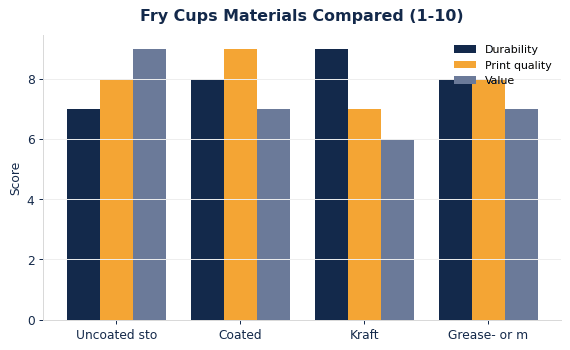
    The common materials for custom fry cups each trade off durability, print quality, and cost: uncoated stock, coated / gloss stock, kraft / recycled, and grease- or moisture-resistant. The right pick depends on how the fry cups will be used, the look you want, and your budget. The chart and table below compare the main options so you can match material to job.

    How common fry cups materials compare on durability, print quality, and value.
    How common fry cups materials compare on durability, print quality, and value.

    As a rule of thumb, choose a recyclable or natural material when eco positioning matters, a coated or laminated option when you want vivid full-color print, and a premium build when the fry cups is part of a gift or high-end presentation. When in doubt, request a sample so you can judge feel and print before committing to a full run.

    Material / option Best for
    Uncoated stock natural, writable surface with a matte look
    Coated / gloss stock vivid color and a polished finish
    Kraft / recycled eco-forward, warm natural tone
    Grease- or moisture-resistant food-safe performance where needed

    Sizing and specs

    Sizing is where many fry cups orders go wrong, so measure before you order. Custom fry cups typically range from a small insert card up to a full wrap or liner sheet, and the right size and weight depends on the product or use they serve. Too small and the fit is tight or the product is exposed; too large and you pay for material you do not need and lose a clean, intentional look.

    When a measurement falls between standard options, size to the product with a small margin rather than guessing. Confirming the size and weight on a proof or sample before a large run prevents the costly mistake of a full order that does not fit, which is far more expensive to fix than a five-minute check up front.

    Branding and decoration

    Decoration is what turns a plain fry cups into a branded one. Digital and offset printing reproduce full-color art crisply, with spot colors and foil available for a premium touch. Match the method to your artwork and budget: simple logos reproduce cleanly and cheaply, while detailed, full-color designs shine with the right process on the right material. Keep the artwork vector where possible and confirm the print area for your chosen size.

    Restraint usually reads as premium. A clean logo, one or two brand colors, and quality material almost always look more considered than a busy, over-printed design. Approving a proof before the run protects both the look and the budget, especially on a large order of custom fry cups.

    Ordering and budget

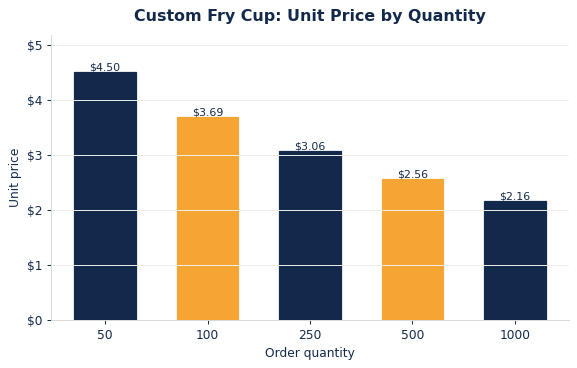
    Per-unit cost on custom fry cups falls steadily with volume as setup amortizes across more pieces, so ordering for real demand rather than a token first batch is usually the efficient move. The curve below shows how pricing typically improves with quantity, which helps you plan an order that balances cash and cost.

    Typical per-unit fry cups pricing as order quantity increases.
    Typical per-unit fry cups pricing as order quantity increases.
    Ordering for a recurring need? A single larger run lowers the unit cost and keeps your branding consistent, while a small overage covers reorders and the occasional damaged piece without a rush order.

    Common mistakes to avoid

    A few avoidable missteps account for most disappointing fry cups orders. Ordering before measuring is the biggest, followed by choosing a material for price alone without considering how the fry cups will actually be used, and skipping the proof on a large run. Each is easy to prevent with a few minutes of planning, and each is expensive to fix once a full order is produced.

    The other common trap is over-designing the artwork. Cramming in too many colors, effects, or details can muddy the print and raise the cost, especially on textured or recycled materials. Simplifying the design to a clean, legible mark almost always improves both the look and the price of your custom fry cups.

    Frequently asked questions about custom fry cups

    What material is best for custom fry cups?

    It depends on the use: choose a recyclable or natural material for eco positioning, a coated or laminated option for vivid full-color print, and a premium build for gifting or high-end presentation. Request a sample to judge feel and print before a full run of custom fry cups.

    How do I choose the right size?

    Measure the product or use the fry cups serves, then size to it with a small margin so the fit is clean without wasting material. When a measurement falls between standard options, size up slightly and confirm the size and weight on a proof before ordering in volume.

    How are custom fry cups branded?

    Digital and offset printing reproduce full-color art crisply, with spot colors and foil available for a premium touch. Match the method to your artwork and budget, keep the art vector where possible, confirm the print area for your size, and approve a proof so the finished custom fry cups match your intent.

    How does pricing work, and is there a minimum?

    Per-unit cost drops with quantity as setup amortizes across the run, so larger orders are more cost-effective. Order for real demand plus a small overage rather than a token batch, and consolidate recurring needs into one run for the best price.

    Can I get a sample or proof before ordering?

    Yes, and it is strongly recommended. A physical sample lets you judge material and print, and a digital or physical proof confirms your artwork, color, and size and weight before a full run — a small step that prevents a costly mistake on a large order.

    What do you need to quote custom fry cups?

    To quote accurately we need the size and weight or the product they serve, the quantity, your material preference, and your artwork or a description of the branding. With those details we can recommend the right material and size and give you pricing for the run, and a proof follows once the order is confirmed.

    Whatever you order, send vector artwork, confirm material and size and weight, and approve a proof before production. For help matching custom fry cups to a specific use, see our companion guide, our How to Choose Custom Fry Cups for Your Brand, and explore our our shop to start your order.

    Ready to order custom fry cups?

    Tell us your product, quantity, and branding and we’ll match the material, size, and decoration for you.

    Get a Quote

  • How to Order Custom Fry Cups for Your Festival or Fair: A Checklist

    Call or Text us: (929) 605-4397

    HomeBlog › How to Order Custom Fry Cups for Your Festival or Fair

    FESTIVALS

    How to Order Custom Fry Cups for Your Festival or Fair: A Checklist

    June 29, 2026 · Custom Fry Cups Team

    Festival and fair organizers juggle a lot more than packaging — vendor logistics, permits, entertainment booking, ticketing. Fry cups are usually one line on a long list, which is exactly why they get ordered late and rushed. Here’s a step-by-step checklist that keeps packaging off your critical-path worry list.

    Whether you’re ordering a single design for your own food stall or coordinating packaging across several vendors under one festival brand, work through these steps in order and count backward from your event date.

    The Ordering Checklist

    1. Lock your event date and work backward

    Everything else on this list depends on this step. With a 2 week production and shipping lead time (faster turnaround available with express shipping) plus 24 hours for mockup turnaround, you need finished, approved artwork in our hands no later than three weeks before your event to have comfortable buffer. If you’re inside that window already, tell us — we’ll flag whether an expedited path is realistic, but don’t assume it by default.

    2. Finalize your logo and quantity together

    Don’t lock quantity before you’ve settled on final art, and don’t finalize art without knowing your expected attendance. These two decisions inform each other: a photo-heavy, multi-color festival graphic points toward full-color printing, which has different plate setup than a simple one-color kraft stamp, and that in turn can affect how efficiently different quantities price out. Settle both roughly at the same time so you’re not re-quoting after a late design change.

    3. Size your quantity to attendance and vendor mix

    Use total expected attendance, the share of attendees likely to buy from your stall specifically, and your fry attach rate to size the order — the same formula we walk through in our sizing guide. For a multi-day festival, treat the full run as one order rather than reordering day to day; running out on day two of a three-day event is a preventable failure.

    4. Submit art and use the full mockup approval window

    Mockups typically come back in 24 hours. Use that window carefully — check color accuracy against your actual brand palette (screen colors and printed colors don’t always match exactly), confirm all text is legible at actual cup size, and double-check any sponsor logos or QR codes are correctly placed and scannable. Requesting a revision after production has started costs real time you may not have; catching it at the mockup stage costs nothing.

    5. Plan for outdoor and weather durability

    Festivals and fairs are outdoor events, which means your fry cups face conditions a restaurant counter never does: wind, direct sun, humidity, and occasionally rain. Grease-resistant kraft paperboard and poly-coated paperboard both hold up to normal outdoor service, but if your festival runs in a hot, humid climate or your stall serves loaded/wetter items, lean toward poly-coated construction for the added moisture barrier — see our materials comparison for the full breakdown. Also plan physical storage: keep boxed inventory off the ground and away from direct sun exposure until it’s needed at the stall, since UV and heat can affect print vibrancy over multi-day outdoor storage.

    6. Coordinate multi-vendor orders if applicable

    If you’re the festival organizer sourcing packaging on behalf of multiple food vendors under a shared festival brand, coordinate this as a single consolidated order wherever possible. It’s simpler to manage, usually prices better at higher combined volume, and ensures visual consistency across every stall. If individual vendors want their own branding instead of a shared festival design, each vendor’s design still needs to meet our 12-unit minimum — an easy bar for any individual stall, but worth communicating to vendors early.

    Timeline at a Glance

    Weeks Before EventAction
    4+ weeks outFinalize logo, confirm quantity, submit art for mockup
    3–4 weeks outApprove mockup, confirm production start
    2–3 weeks outProduction and shipping in progress
    1 week outConfirm delivery, arrange on-site storage plan
    Event weekCups on-site, stored out of direct sun/heat until service
    Key takeaway

    Work backward from your event date with a 3 week buffer, use the full mockup review window, and consolidate multi-vendor orders into one run whenever branding allows.

    Choosing for Your Order

    Festival timelines are unforgiving once the date is set, so the earlier packaging enters the conversation, the more options you have. If you’re planning a festival or fair and want to map out a timeline against your specific event date, reach out and we’ll build the schedule with you.

    Ready to move forward? Get a custom quote in one business day, learn more about Custom Fry Cups, or browse more posts on the blog.

    More Posts

    ORDERING

    How Many Fry Cups Should You Order?

    Read more →

    FOOD TRUCKS

    A Food Truck’s Guide to Custom Fry Cup Branding

    Read more →

    MATERIALS

    Grease-Resistant Paperboard vs. Poly-Coated

    Read more →

    BUYER GUIDES

    Kraft Stamped vs. Full-Color Printed Fry Cups

    Read more →

  • A Restaurant Group’s Guide to Fry Cup Margins and Bulk Pricing

    Call or Text us: (929) 605-4397

    HomeBlog › A Restaurant Group’s Guide to Fry Cup Margins and Bulk Pricing

    BUYER ECONOMICS

    A Restaurant Group’s Guide to Fry Cup Margins and Bulk Pricing

    June 15, 2026 · Custom Fry Cups Team

    Packaging is one of the few line items in a restaurant’s cost structure that’s fully within your control before the food ever touches it — you choose the vendor, the quantity, and the order cadence. For multi-location groups, getting fry cup sourcing right is a genuine margin lever, not a rounding error. Here’s how to think about it the way a controller would.

    This guide covers how packaging cost fits into food cost percentage, what volume price breaks realistically look like, how multi-location groups should structure ordering, and how to budget packaging into a new menu item launch.

    Where Packaging Fits in Food Cost Percentage

    Most restaurant groups track food cost as a percentage of menu price, and packaging typically gets bucketed into that calculation either directly or as an adjacent “paper cost” line. A fry cup’s per-unit cost — which varies with size, material, and print complexity — is a small number in isolation, but it compounds across volume: a location doing 3,000 fry orders a month is paying that per-cup cost tens of thousands of times a year — per location. Multiply by a 12-location group and packaging on fry cups alone becomes a meaningful annual spend. That’s exactly the kind of number that justifies deliberate sourcing rather than defaulting to whatever a broad-line distributor stocks.

    The practical way to think about it: the cup rides on top of the food cost (potatoes, oil, labor allocation) already built into every fry order, so packaging adds measurable points to your effective cost on that item. Stepping down to a better per-unit rate at a higher volume tier claws back margin on every single fry order — without changing the recipe, the price, or the portion.

    Illustrative Volume Price Breaks

    Pricing depends on cup size, material, and print complexity, so treat the table below as a framework for how volume moves your per-unit cost, not an exact quote.

    Order VolumeWhere It Typically Lands in the Per-Unit Range
    Smaller runsUpper-middle to top of range — setup and plate costs are spread across fewer units
    2,500 unitsMiddle of range — meaningful step down from small-run pricing
    10,000+ unitsLower end of range — setup cost is fully amortized across a large run
    Key takeaway

    Packaging cost is a controllable input to food cost percentage — consolidating volume into fewer, larger orders is one of the most direct margin levers available on a per-item basis.

    Multi-Location Consolidated Ordering

    The single biggest pricing mistake we see multi-location groups make is letting each location or franchisee order independently. Five locations each ordering 2,000 units a quarter is functionally the same total volume as one consolidated 10,000-unit order — but the consolidated order lands in a meaningfully better price tier, requires one art-approval cycle instead of five, and simplifies your accounting to a single PO instead of five. If your group operates under a shared brand standard, there’s rarely a good reason to fragment fry cup ordering by location. The main exception is genuine regional menu variation (different sub-brands or concepts under one parent company), where each concept’s distinct branding needs its own order to begin with.

    For groups scaling past a handful of locations, we recommend setting a standing quarterly or semi-annual order cadence tied to a rolling forecast rather than reactive per-location reordering. It’s both operationally simpler and pricing-favorable.

    Budgeting for a New Menu Item Launch

    When a new fry-adjacent item is launching — a loaded fries platform, a limited-time offer, a new size tier — build packaging into the launch budget from day one rather than treating it as an afterthought once the recipe is finalized. Three things to lock early: the cup size and material (loaded items generally call for poly-coated construction and possibly the Loaded Fry Boat format), the print approach (full-color if the LTO has dedicated campaign branding), and the launch-quantity order sized to your projected trial rate across the launch window, not your steady-state run rate. Ordering too conservatively on a launch item risks a packaging stockout right when marketing momentum is highest; a 15–20% buffer above your forecast is reasonable for a first-time item with no sales history to model against.

    Choosing for Your Order

    If you’re evaluating fry cup sourcing across a multi-location group, bring us your per-location volume and current spend and we’ll model what a consolidated order structure would save relative to fragmented ordering.

    Ready to move forward? Get a custom quote in one business day, learn more about Custom Fry Cups, or browse more posts on the blog.

    More Posts

    ORDERING

    How Many Fry Cups Should You Order?

    Read more →

    MATERIALS

    Grease-Resistant Paperboard vs. Poly-Coated

    Read more →

    BUYER GUIDES

    Kraft Stamped vs. Full-Color Printed Fry Cups

    Read more →

    SPORTS VENUES

    Custom Fry Cups for Stadiums and Sports Venues

    Read more →

  • Grease-Resistant Paperboard vs. Poly-Coated: What’s the Difference?

    Call or Text us: (929) 605-4397

    HomeBlog › Grease-Resistant Paperboard vs. Poly-Coated

    MATERIALS

    Grease-Resistant Paperboard vs. Poly-Coated: What’s the Difference?

    May 27, 2026 · Custom Fry Cups Team

    Buyers often assume “fry cup material” is a single category, then get surprised when we ask which construction they want. It matters. The two base materials we build custom fry cups from — grease-resistant kraft paperboard and poly-coated paperboard — handle moisture differently, feel different in the hand, and carry different cost and recyclability trade-offs. Neither is universally better; each is built for a different job.

    Here’s what’s actually different, explained without the jargon.

    How Each Material Stops Grease and Moisture

    Grease-resistant kraft paperboard gets its barrier property from a chemical treatment applied to or impregnated into the paper fibers themselves during manufacturing. The treatment makes the fiber structure resistant to oil penetration without adding a separate plastic layer. It’s a “the paper itself repels grease” approach.

    Poly-coated paperboard takes a different approach entirely: a thin layer of polyethylene (or a similar polymer) is laminated onto the paperboard surface as a physical barrier film. Grease and moisture can’t penetrate because they hit a plastic layer before they ever reach the paper fiber underneath. It’s a “the paper is wrapped in a barrier” approach rather than a treated-fiber approach.

    Side-by-Side Comparison

    Barrier methodGrease-Resistant: treated paper fiber  |  Poly-Coated: laminated polyethylene film
    Feel / rigidityGrease-Resistant: slightly softer, more paper-like hand-feel  |  Poly-Coated: stiffer, more rigid structure, holds shape under load
    Moisture performanceGrease-Resistant: strong against oil, moderate against wet/liquid content  |  Poly-Coated: strong against both oil and liquid, better for wetter foods
    Recyclability considerationsGrease-Resistant: generally accepted in more standard paper recycling streams  |  Poly-Coated: often requires specialized recycling due to the plastic laminate; check local municipal guidance
    Relative costGrease-Resistant: lower end of price range  |  Poly-Coated: mid-to-upper end of price range
    Best use caseGrease-Resistant: straight fries, onion rings, dry-to-moderately-oily items  |  Poly-Coated: loaded fries, chili-cheese, wetter toppings, longer hold times under heat lamps
    Key takeaway

    Grease-resistant kraft handles straight fries well at a lower cost; poly-coated paperboard is the stronger choice any time the item is wetter, loaded, or held longer before it’s eaten.

    Which One Should You Choose

    If your fry cup is holding straight fries, onion rings, or another relatively dry fried item that’s served and eaten within a few minutes, grease-resistant kraft paperboard performs well and costs less. This covers the majority of food truck, restaurant, and bar use cases where the cup goes from fryer basket to customer’s hand in short order.

    If your fry cup is holding a loaded item — chili-cheese fries, nacho-style toppings, anything with sauce, cheese, or gravy — or if the item sits under a heat lamp or in a concession queue for an extended period before being eaten, poly-coated paperboard is worth the incremental cost. The polyethylene layer holds up against sustained moisture exposure in a way treated fiber alone doesn’t, which matters for structural integrity: a soggy cup that loses rigidity is a real failure mode at a stadium concourse or festival stall where the cup gets carried and jostled before the food is consumed.

    Our Loaded Fry Boat is built specifically with poly-coated construction in mind given what it’s designed to hold, while the Classic Fry Cup and Kraft Stamped Fry Cup commonly ship in grease-resistant kraft for straight fry orders.

    A Note on Recyclability

    This is the question we get most from environmentally conscious buyers. Grease-resistant kraft paperboard, because it doesn’t contain a separate plastic laminate, is more likely to be accepted in standard curbside paper recycling — though local rules on grease-contaminated paper still vary by municipality. Poly-coated paperboard’s polyethylene layer means it typically needs to go through a specialized recycling stream that separates the plastic laminate from the paper fiber; not every municipal program supports this, so it more often ends up in general waste unless a commercial composting or specialized recycling program is available. If recyclability is a stated priority for your brand, grease-resistant kraft is the more defensible default, reserved for poly-coated only where the wetter-food use case genuinely requires it.

    Choosing for Your Order

    Match the material to what’s actually going in the cup, not to habit. If you’re ordering a mixed lineup — straight fries on one item, loaded fries on another — it’s common and reasonable to order both constructions for different SKUs. Tell us your menu and we’ll recommend material by item.

    Ready to move forward? Get a custom quote in one business day, learn more about Custom Fry Cups, or browse more posts on the blog.

    More Posts

    BUYER GUIDES

    Kraft Stamped vs. Full-Color Printed Fry Cups

    Read more →

    SPORTS VENUES

    Custom Fry Cups for Stadiums and Sports Venues

    Read more →

    ORDERING

    How Many Fry Cups Should You Order?

    Read more →

    BUYER ECONOMICS

    A Restaurant Group’s Guide to Fry Cup Margins and Bulk Pricing

    Read more →

  • A Food Truck’s Guide to Custom Fry Cup Branding

    Call or Text us: (929) 605-4397

    HomeBlog › A Food Truck’s Guide to Custom Fry Cup Branding

    FOOD TRUCKS

    A Food Truck’s Guide to Custom Fry Cup Branding

    May 9, 2026 · Custom Fry Cups Team

    A food truck has no storefront, no signage lease, no window display. What it has is a service window and whatever’s in the customer’s hand when they walk away from it. That makes packaging one of the highest-leverage branding investments a mobile food business can make — and a generic, unbranded fry cup is a missed impression every single order.

    This guide covers why branded packaging matters disproportionately for trucks, how to run the MOQ math whether you operate one truck or a small fleet, and where a mini cup fits into your festival and sampling strategy.

    Why a Branded Cup Outperforms a Generic One for a Mobile Business

    A restaurant customer sees your name on the door, the menu board, the receipt, and the to-go bag. A food truck customer typically sees your name once — on the truck itself while they’re in line — and then the only branded surface in front of them for the next ten minutes is the packaging in their hand. If that packaging is a plain white or brown cup with no identity, you’ve spent your one branding impression and gotten nothing back. A logo-printed cup keeps working after the transaction: it’s what’s visible in every photo a customer takes, what sits on the table next to them, and what a stranger walking by associates with your food when they see it in someone else’s hand.

    There’s also a repeat-business angle specific to trucks. Because trucks move locations and don’t always post a fixed schedule, customers often find you again by remembering a name or logo rather than a street address. A cup that carries your name, your city or truck-finder handle, or a QR code to your schedule turns a single sale into a repeat-visit mechanism at zero incremental cost per order.

    The Social-Media and Photogenic Packaging Angle

    Food trucks depend on organic social content more than almost any other food-service format — a strong Instagram or TikTok presence is often how a truck builds a following before it ever has a fixed address. A branded, well-designed fry cup is inexpensive, reliable user-generated content: customers photograph food they’re proud of, and a cup with clean branding in-frame does marketing work you didn’t have to produce yourself. This is one of the strongest arguments for full-color printing over a plain kraft stamp if your brand has vibrant colors or a distinctive logo — it’s the difference between a photo that reads as “random takeout” and one that reads as “this specific truck.”

    MOQ Math: Single Truck vs. Multi-Truck Fleet

    Our 12-unit minimum per design means quantity is never a barrier for a single truck. A truck doing 60–100 covers a day with a 40–50% fry attach rate moves through roughly 250–450 fry orders a week, meaning a 500-unit order covers one to two weeks of service — but since you’re paying for setup and plates regardless of quantity, most single-truck operators order 1,000–1,500 units at a time to stretch the per-unit cost down and reduce reorder frequency to roughly monthly.

    Multi-truck fleets should consolidate ordering across trucks rather than ordering per-truck. A three-truck fleet each doing similar volume to the example above can combine into a single 3,000–5,000 unit order, which usually moves the whole fleet into a meaningfully better price tier than three separate 1,000-unit orders would. The only reason to keep trucks on separate orders is if they run genuinely different branding (different concept names under one parent company) — in that case each concept’s design still needs to meet the 12-unit minimum.

    Operation SizeSuggested Order Pattern
    Single truck, standard volume1,000–1,500 units, reorder monthly
    Single truck, weekend-only / seasonal500 units, reorder per season
    2–3 truck fleet, shared brandingConsolidate to 3,000–5,000 units per order
    4+ truck fleet, shared branding8,000+ units, quarterly ordering for best price tier
    Key takeaway

    A branded fry cup is one of the only marketing touchpoints a food truck controls after the transaction — and consolidating fleet orders across trucks unlocks meaningfully better pricing than ordering truck-by-truck.

    The Mini Cup for Festival Sampling

    If your truck does festival or fair circuits, the Mini Fry Cup deserves a place in your packaging lineup separate from your standard order size. A smaller branded sample cup lets you offer a low-priced taste-size portion at high-traffic festival stalls, which increases trial among festival-goers who wouldn’t commit to a full-size purchase from an unfamiliar truck. It’s also useful for pairing with a bounce-back offer — a QR code on the mini cup pointing to your schedule or a discount on your next full-size order turns a small sample into a lead for a future full-price customer.

    Choosing for Your Order

    Whether you’re outfitting one truck or coordinating a fleet, the goal is the same: make sure every cup that leaves your window is doing branding work, not just holding fries. Send us your logo and your current volume and we’ll help you land on the right size and order cadence.

    Ready to move forward? Get a custom quote in one business day, learn more about Custom Fry Cups, or browse more posts on the blog.

    More Posts

    ORDERING

    How Many Fry Cups Should You Order?

    Read more →

    BUYER GUIDES

    Kraft Stamped vs. Full-Color Printed Fry Cups

    Read more →

    FESTIVALS

    How to Order Custom Fry Cups for Your Festival or Fair

    Read more →

    MATERIALS

    Grease-Resistant Paperboard vs. Poly-Coated

    Read more →

  • Custom Fry Cups for Stadiums and Sports Venues: A Concession Buyer’s Guide

    Call or Text us: (929) 605-4397

    HomeBlog › Custom Fry Cups for Stadiums and Sports Venues

    SPORTS VENUES

    Custom Fry Cups for Stadiums and Sports Venues: A Concession Buyer’s Guide

    April 21, 2026 · Custom Fry Cups Team

    Stadium concessions run under conditions most food packaging never sees: three-plus hours of continuous service, high-volume line speed, and product that sits under heat lamps or gets carried up and down stadium stairs before it’s eaten. A cup that works fine at a sit-down restaurant can fail at a stadium concourse. Here’s what concession buyers need to know before placing an order.

    We work with concession operators and stadium food-service contractors who need packaging that holds up to volume, holds its branding under bright venue lighting, and lands in time for opening day. This guide covers the four things that matter most: durability, branding, format, and timing.

    Durability Under Three Hours of Game-Day Conditions

    A stadium fry cup isn’t judged on how it looks fresh out of the box — it’s judged on how it holds up after sitting under a heat lamp for 20 minutes, getting carried through a crowd, and absorbing grease from a loaded topping. Our fry cups use grease-resistant kraft paperboard or poly-coated paperboard construction specifically because standard uncoated paper stock will go soft and translucent within minutes under heat-lamp conditions — unacceptable when a fan is carrying a cup back to their seat through three sections of stairs. The poly-coated option in particular adds a moisture barrier that matters for loaded or wet-topped items like chili-cheese fries or nacho-style loaded boats, which sit longer at concession stands than a straight order of fries.

    Branding for Team Colors and Sponsor Logos

    Stadium branding has two audiences: the venue’s own brand (team colors, mascot, stadium name) and sponsor placements that are often contractually required. Full-color flexo printing is the standard choice here because it’s the only process that reliably reproduces exact team Pantone colors alongside a sponsor logo without compromising either. We’ve found stadium and arena buyers typically want at minimum two elements on the cup: the team or venue mark in brand color, and a sponsor logo or QR code in a secondary position. Both fit cleanly on a full-color print run; a single-color kraft stamp is not usually the right fit here, since stadium branding tends to prioritize color accuracy and sponsor visibility over an artisanal look.

    Format: 16oz Large Cup vs. Loaded Fry Boat

    Stadium concessions typically choose between two formats depending on what’s on the menu. The Large Fry Cup (16oz) is the better fit for straight fry orders sold as a standalone item or side — it holds enough volume for a shareable portion without the structural demands of a loaded item. The Loaded Fry Boat is purpose-built for nacho-style or chili-cheese loaded concessions, where the wider, shallower boat shape keeps toppings from pooling at the bottom and makes the item easier to eat one-handed in a crowd — a real consideration when your customer is standing in a concourse or seated in a narrow row.

    FormatBest Use Case
    Large Fry Cup (16oz)Straight fries, deep-well format, high-volume standalone orders
    Loaded Fry BoatNacho-style loaded fries, chili-cheese, wetter toppings, easier eating in tight seating
    Classic Fry Cup (12oz)Standard combo-meal side portion at smaller concession counters
    Key takeaway

    Build stadium orders around full-color printing for sponsor and team-color accuracy, and match the cup format — large cup vs. loaded boat — to what’s actually on the menu.

    Ordering Timelines Around a Season Schedule

    The biggest mistake stadium and arena buyers make is treating a season-long packaging order like a single-event order. With a 2 week production and shipping lead time (faster turnaround available with express shipping) and 24 hour mockup turnaround, the math is straightforward but unforgiving: if your season opener is set, you need art approved and the order placed no later than three weeks out, with buffer for a revision round on the mockup. For venues running 8–10 home games in a season, we strongly recommend ordering the full season’s volume in one batch rather than reordering game-by-game — it locks in a better per-unit price and removes the risk of a mid-season stockout if a playoff run extends your schedule beyond the original game count. Build in roughly 10–15% extra volume for exactly that scenario.

    Choosing for Your Order

    Stadium and arena orders are some of the most format- and timeline-sensitive we handle. If you’re sourcing for a season, tell us your home game count, expected per-game attendance, and any sponsor requirements up front — we’ll size the order and lock a production schedule that has your first shipment on the concourse before opening day.

    Ready to move forward? Get a custom quote in one business day, learn more about Custom Fry Cups, or browse more posts on the blog.

    More Posts

    ORDERING

    How Many Fry Cups Should You Order?

    Read more →

    BUYER GUIDES

    Kraft Stamped vs. Full-Color Printed Fry Cups

    Read more →

    MATERIALS

    Grease-Resistant Paperboard vs. Poly-Coated

    Read more →

    FESTIVALS

    How to Order Custom Fry Cups for Your Festival or Fair

    Read more →

  • Kraft Stamped vs. Full-Color Printed Fry Cups: Which Fits Your Brand

    Call or Text us: (929) 605-4397

    HomeBlog › Kraft Stamped vs. Full-Color Printed Fry Cups

    BUYER GUIDES

    Kraft Stamped vs. Full-Color Printed Fry Cups: Which Fits Your Brand

    April 2, 2026 · Custom Fry Cups Team

    Every buyer we talk to eventually asks the same question in different words: should our logo be stamped in a single ink onto natural kraft, or printed edge-to-edge in full color? Both are legitimate, widely used approaches — the right answer depends on your brand’s visual identity, your budget per unit, and how much lead time you have.

    This is not a quality comparison. Both processes hold up equally well under grease and heat when built on the right paperboard. It’s a design and cost decision, and it’s worth five minutes of thought before you commit to 500 or 5,000 units.

    What Each Process Actually Is

    Kraft stamped means your logo or wordmark is stamped in one or two ink colors directly onto natural, unbleached kraft paperboard. The brown of the kraft stays visible as your background. It’s the same visual language as a bakery box or an artisanal coffee bag — understated, textural, and immediately read as “handmade” or “small batch,” even when you’re ordering thousands of units.

    Full-color printed uses flexographic printing to lay down a complete CMYK (or spot-color-extended) design across the entire cup, including photographic elements, gradients, sponsor logos, and saturated brand colors. The cup’s true finish (white or colored poly-coated board) becomes your canvas rather than a visible background tone.

    Side-by-Side Comparison

    FactorKraft Stamped
    Full-Color Printed 
    Approx. cost per unitKraft Stamped: lower end of the range  |  Full-Color: mid-to-upper end of range
    Typical turnaroundKraft Stamped: 2 weeks (faster turnaround available with express shipping)  |  Full-Color: 2 weeks, more art-approval rounds
    Visual impactKraft Stamped: rustic, tactile, understated  |  Full-Color: bold, vibrant, photo-real
    Best-fit brand typeKraft Stamped: artisanal, farm-to-table, coffee/bakery-adjacent  |  Full-Color: sports, festivals, sponsor-driven, high-energy QSR
    Color countKraft Stamped: 1–2 spot colors  |  Full-Color: unlimited (full CMYK)
    MOQ nuanceKraft Stamped: 12-unit minimum applies per design, single stamp die is reusable across colorways  |  Full-Color: 12-unit minimum per design, new plates needed for major art changes
    Key takeaway

    Choose kraft-stamped for a rustic, budget-forward look built on one or two colors; choose full-color for vibrant, sponsor-ready branding that needs the whole cup as canvas.

    When Kraft-Stamped Wins

    Kraft-stamped is the right call when your brand identity already leans rustic, farm-to-table, or small-batch — think a local burger stand with a hand-drawn logo, a brewery taproom, or a food truck whose whole aesthetic is “we made this ourselves.” The natural kraft background does visual work for you: it reads as premium and intentional without requiring a complex design. It’s also the better choice when budget per unit matters more than maximum visual punch, since fewer ink stations and simpler plate setup keep costs toward the lower end of our price range. If your logo is primarily a wordmark or a simple one-color mark, kraft-stamped will render it cleanly with no loss of legibility.

    When Full-Color Printed Wins

    Full-color is the right call any time your design needs more than your logo — think team colors and a sponsor logo for a stadium concession, a festival lineup graphic, gradients and photography for a fast-casual chain rollout, or any design where the cup itself functions as an advertisement people photograph and share. If your brand guidelines specify exact Pantone-matched brand colors across a multi-location rollout, full-color printing gives you the consistency and saturation that a one-color stamp can’t replicate. It’s also the better fit when the fry cup is a primary branding touchpoint rather than a secondary one — for example, a dedicated loaded-fries concept where the cup itself is part of the product experience.

    A Middle Path: Two-Color Kraft

    Many buyers don’t realize there’s a middle option: stamping two spot colors onto kraft instead of one. This lets you add an accent color — team red, a mustard highlight, a second brand color — while keeping costs closer to the kraft-stamped end of the range and turnaround on the faster side. It’s worth asking about if you want more visual presence than a single-color stamp but don’t need the full CMYK treatment.

    Choosing for Your Order

    If you’re still unsure, send us your logo and brand colors. We’ll tell you honestly which process will render it best and mock up both options side by side before you commit to a print run.

    Ready to move forward? Get a custom quote in one business day, learn more about Custom Fry Cups, or browse more posts on the blog.

    More Posts

    MATERIALS

    Grease-Resistant Paperboard vs. Poly-Coated

    Read more →

    SPORTS VENUES

    Custom Fry Cups for Stadiums and Sports Venues

    Read more →

    FOOD TRUCKS

    A Food Truck’s Guide to Custom Fry Cup Branding

    Read more →

    ORDERING

    How Many Fry Cups Should You Order?

    Read more →

  • How Many Fry Cups Should You Order? A Sizing Formula for Every Event

    Call or Text us: (929) 605-4397

    HomeBlog › How Many Fry Cups Should You Order?

    ORDERING

    How Many Fry Cups Should You Order? A Sizing Formula for Every Event

    March 18, 2026 · Custom Fry Cups Team

    The single most common question we get from first-time buyers is not about print quality or lead time — it’s “how many do I actually need.” Order too few and you run out mid-shift with an unhappy line. Order too many and you’re storing a few thousand extra cups in a supply closet for a year.

    Fry cup quantity is not a guess. It’s a function of three numbers you already have: how many covers you expect, what share of those covers order fries, and how many separate events or turns you’ll use the cups across before reordering. Below is the formula we walk every buyer through, plus worked examples across four common order types.

    The Core Formula

    Start here: Quantity = Expected Covers × Fry Attach Rate × Turns × Buffer Multiplier.

    Break that down:

    Expected covers is your total guest count, ticketed attendance, or projected transaction count for the period you’re ordering against.

    Fry attach rate is the percentage of transactions that include a fry order. Most quick-service operators run 35–55% attach on fries as a side; dedicated fry concepts (loaded fries, poutine trucks) run closer to 90–100% since fries are the primary item.

    Turns is how many times you’ll use this batch of cups — a single weekend, a full season, or a rolling month of service. Ordering for multiple turns spreads your per-unit cost down and avoids reordering mid-season.

    Buffer multiplier covers spoilage, double-cupping loaded orders, staff training waste, and demand upside. We recommend 1.10–1.15 (10–15% buffer) for most operators, rising to 1.20 for a first-time event where demand is unproven.

    Worked Examples

    Food truck, single weekend. A truck expecting 400 covers over a two-day weekend, 45% fry attach, one turn, 15% buffer: 400 × 0.45 × 1 × 1.15 = 207, typically rounded up to a clean 250-cup run. With our 12-unit minimum, the formula — not the minimum — sets your quantity; more on that below.

    Stadium, single game day. A concession stand projecting 3,200 fans through its section, 30% fry attach (fries competing with nachos and other sides), one turn, 10% buffer: 3,200 × 0.30 × 1 × 1.10 = 1,056. Most stadium accounts round this to 1,200–1,500 to cover a sellout or a playoff bump.

    Festival, three-day weekend. A festival fry vendor expecting 9,000 total attendees across three days, 20% of attendees buying from this specific stall, 60% fry attach among that group, treated as one turn covering all three days, 15% buffer: 9,000 × 0.20 × 0.60 × 1.15 = 1,242, typically rounded to 1,500 to leave room for a strong Saturday.

    Restaurant group, monthly standing order. A fast-casual location doing roughly 5,000 covers a month, 50% fry attach, ordering monthly (12 turns a year, but sized per single month), 10% buffer: 5,000 × 0.50 × 1 × 1.10 = 2,750 per month, which many groups round up and order quarterly at 8,000–9,000 to hit better price breaks and reduce reorder frequency.

    Suggested Quantity by Event Type

    Event / Operation TypeSuggested Quantity Range
    Food truck, single weekend or one-off event250–500
    Food truck, monthly recurring service1,000–2,000
    Stadium concession stand, single game day1,000–1,800
    Stadium concession, full season (8–10 home games)8,000–15,000
    Festival or fair, weekend event1,200–3,000
    Bar or brewery, monthly service750–1,500
    Restaurant group, single location per month2,000–3,500
    Restaurant group, multi-location quarterly10,000+
    Corporate catering, single event500–1,000
    Key takeaway

    Multiply covers by fry attach rate by turns, add a 10–15% buffer, then round up to the nearest volume price break — not down.

    Where the 12-Unit Minimum Fits In

    Our minimum order quantity is just 12 units per design. For smaller operations — a single food truck, a pop-up, a one-off corporate event — that means the minimum will almost never be the constraint: the formula above sets your quantity, and you can order exactly what the math says you need. Many smaller buyers still round up a little, since you’re already paying for the print run and setup and surplus stock carries over to your next event.

    For larger operations — stadiums, multi-location restaurant groups, festival organizers coordinating several vendors — the MOQ is irrelevant because your real demand runs into the thousands. The more useful question for you is which volume tier gets you the best per-unit price, which is where ordering in fewer, larger batches (quarterly instead of monthly, seasonal instead of per-game) pays off.

    Buffer Stock: How Much Is Enough

    Buffer stock exists for three reasons: transactions run higher than forecast, staff double-cup loaded or wet orders, and a percentage of cups get damaged or mis-printed in normal handling. A 10% buffer covers routine variance. Push to 15–20% if any of the following apply: this is your first order and you don’t have historical attach-rate data, you’re running an outdoor event exposed to wind or rain, you have multiple stations pulling from the same stock, or the event has upside scenarios (a home team in the playoffs, a headliner added late to a festival lineup) that could spike demand well above your baseline forecast.

    Choosing for Your Order

    The formula gets you close; the last step is comparing your number against the volume price breaks and rounding to whichever tier gives you the best per-unit cost without overbuying more than a season or two of runway. If you’re unsure which tier makes sense for your specific covers and cadence, send us your numbers and we’ll size it with you.

    Ready to move forward? Get a custom quote in one business day, learn more about Custom Fry Cups, or browse more posts on the blog.

    More Posts

    SPORTS VENUES

    Custom Fry Cups for Stadiums and Sports Venues

    Read more →

    FOOD TRUCKS

    A Food Truck’s Guide to Custom Fry Cup Branding

    Read more →

    FESTIVALS

    How to Order Custom Fry Cups for Your Festival or Fair

    Read more →

    BUYER ECONOMICS

    A Restaurant Group’s Guide to Fry Cup Margins and Bulk Pricing

    Read more →