A fry cup has one job that its material chemistry has to support: hold hot, oily fries for the length of a meal without going limp or letting grease wick through to a customer’s hand. For years the cheapest way to guarantee that barrier was a fluorinated coating, part of the family of chemicals known as PFAS. That option is now closing. A wave of state laws has made intentionally added PFAS illegal in food packaging, and the compliance question has moved from a sustainability nice-to-have to a purchasing requirement. If you print fry cups for a chain, a distributor, or a single busy stand, here is what the rules actually say and how to buy around them.
What the PFAS bans actually cover
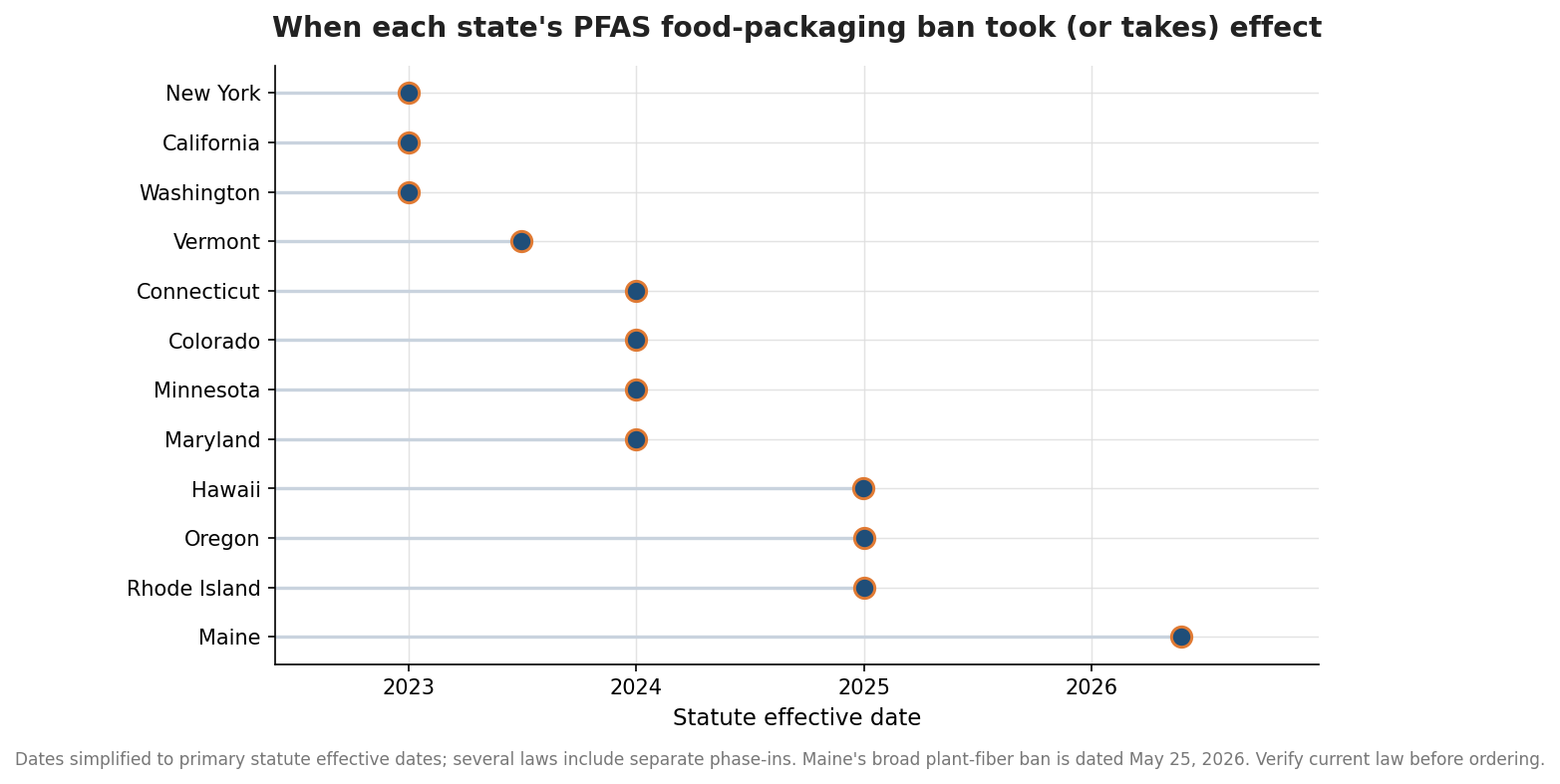
PFAS, short for per- and polyfluoroalkyl substances, are prized in packaging precisely because they repel oil and water. That same persistence is why they are being pulled out of the food stream. As of 2025 and into 2026, roughly a dozen states have restrictions on PFAS in food packaging that are already in force, beginning with New York at the end of 2022 and California in January 2023, followed by Washington, Vermont, and Connecticut in 2023, then Colorado, Minnesota, Maryland, and Hawaii through 2024, and Oregon and Rhode Island at the start of 2025. Maine’s broad plant-fiber packaging ban carries an effective date of May 25, 2026, and New Mexico’s food-packaging restriction is scheduled to begin in 2027. The chart below shows how quickly that list has grown.
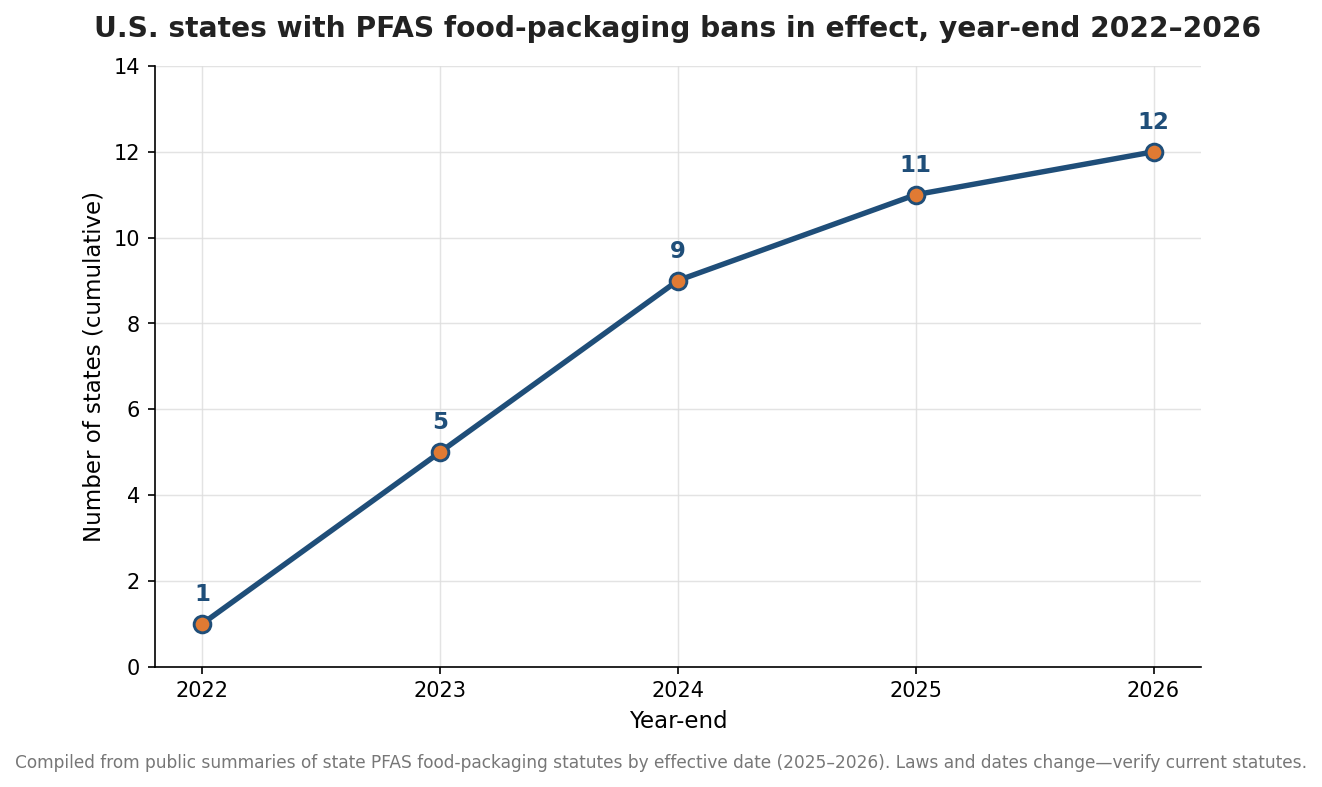
The common language across most of these statutes is intentionally added PFAS, meaning the manufacturer deliberately used a PFAS compound to achieve a function such as grease resistance. A few states go further on measurement: California screens plant-fiber packaging against a threshold of 100 parts per million of total organic fluorine, which catches PFAS that arrive as a contaminant rather than a deliberate ingredient. For a fry cup buyer, the practical takeaway is that “we didn’t add it on purpose” is not automatically a defense in every state, and total-fluorine testing is the backstop.
Why fry cups were a PFAS hotspot in the first place
Grease is the whole problem. A paperboard fry cup filled with salted, oily fries faces one of the harder barrier challenges in disposable foodservice: high fat content, heat, and long dwell time while the customer works through the portion. Fluorochemical treatments solved that with very little coating weight, which kept the cup light, printable, and cheap. Molded-fiber and unbleached kraft cups were especially likely to carry a fluorinated treatment because the raw fiber alone does not hold back oil. That is exactly why regulators singled out fiber-based foodware, and why a cup marketed as “natural kraft” is not automatically PFAS-free. The absence of a plastic lining tells you nothing about whether a fluorinated barrier was applied to the fiber.
How to tell whether a fry cup is compliant
The timeline of effective dates matters because your obligation follows the state where the cup is sold and used, not where it is printed. If you supply venues across several states, you should assume you are governed by the strictest one on your list.
Documentation is how you prove compliance, and there are three pieces worth demanding. The first is a certificate of compliance or a supplier declaration that no PFAS were intentionally added, ideally naming the state laws it is written against. The second is total organic fluorine test data, since a lab result below roughly 100 ppm is the number California-style rules look for and the cleanest evidence you can hand a customer or auditor. The third is a grease-resistance rating, because a cup that is PFAS-free but leaks oil in twenty minutes is not fit for fries. Ask for all three in writing before you commit to a plate change; a reputable converter will have them on file.
The grease barrier without the fluorochemicals
Removing PFAS does not mean accepting a soggy cup. The industry has moved to several PFAS-free barrier approaches, each with trade-offs worth understanding before you specify. Water-based (aqueous) dispersion coatings are the most common drop-in for printed paperboard; they build a thin polymer film that holds back grease and can still be repulped or, in some formulations, composted, though grease holdout varies by coating weight and by brand. Bio-based linings such as PLA give a strong moisture and oil barrier and support certified-compostable claims, but PLA softens under sustained heat, so it fits warm fries better than food that sits scalding for long stretches. Molded bagasse and heavier virgin-fiber constructions lean on denser fiber and mineral or clay treatments to slow oil migration, trading a little coating chemistry for more material. None of these is a universal winner; the right pick depends on portion temperature, dwell time, whether you need a compostable end-of-life claim, and your unit budget.
Reading a spec sheet and a kit rating
When you compare quotes, the grease number to look for is often reported as a kit rating. The 3M Kit Test, standardized as TAPPI T-559, rates a surface’s resistance to oil and grease on a 1-to-12 scale, where a higher number means the paper resisted a more aggressive oil-and-solvent mixture without penetration. It is an indicative bench test rather than a guarantee of real-world performance, so treat it as a comparison tool: a cup rated in the mid-to-upper range will generally outlast a low-rated one under the same fries. Pair the kit number with a plain question about dwell time, such as how the cup performs after twenty to thirty minutes of hot, oily contact, since that is closer to how a fair or stadium portion is actually eaten. Ask, too, whether any composability claim is backed by a recognized certification, because “compostable” and “PFAS-free” are separate claims and a cup can be one without being the other.
What to confirm before you print a full run
Before committing artwork and a five-figure quantity, put five things in the purchase order: a written PFAS-free declaration naming the relevant state laws, total-fluorine test data if you sell into California or similar states, a stated grease-resistance rating, a clear end-of-life claim with any certification behind it, and a firm answer on whether the stock will hold your print quality now that the barrier chemistry has changed. Aqueous coatings and fiber linings can shift how ink sits on the surface, so it is worth pulling a small proof on the exact compliant stock rather than approving color on last year’s cup. Getting those confirmations up front is far cheaper than discovering a compliance or performance gap after the cups are boxed, and it lets you tell your own customers, honestly, that the fries are going into a cup that meets the law in every state you serve.
Leave a Reply